Stuck, Numb, or Unmotivated? Your Nervous System Might Be in Freeze
There’s a particular state many of my clients describe, often with a lot of confusion and self-judgment:
“I’m not panicking anymore… but I feel flat.”
“I know I should do things, but I just can’t.”
“I feel heavy, unmotivated, kind of numb.”
If you’ve ever found yourself here, I want to be very clear:
Nothing is wrong with you.
What you’re experiencing may be a very human nervous system response called freeze.
This post is meant to help you understand what the freeze response is, why it happens, and how to gently support your system back toward a sense of movement and aliveness, without forcing, shaming, or “pushing through”.
What Is the Freeze Response?
The freeze response is one of the body’s built-in survival strategies, alongside fight and flight.
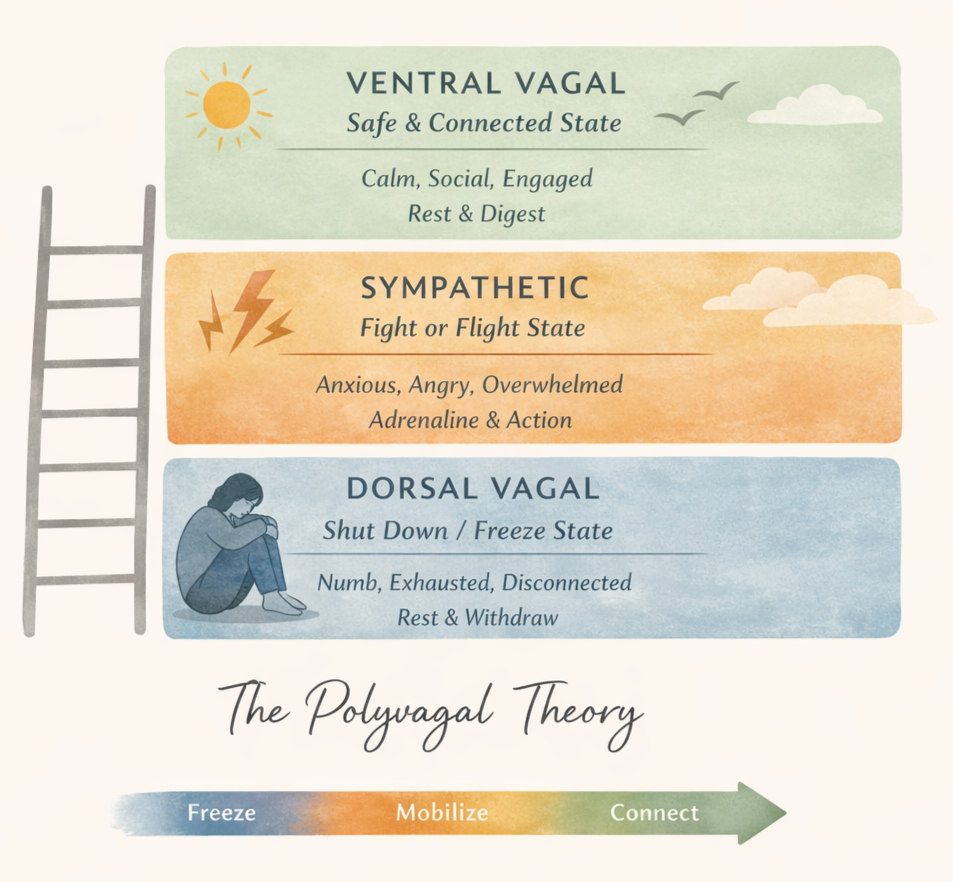
A visual overview of the nervous system states described by Polyvagal Theory. These shifts are adaptive responses to safety, stress, and threat—not personal failures.
From a nervous system perspective (often explained through polyvagal theory), freeze is associated with a dorsal vagal state: a state of shutdown or conservation.
Freeze doesn’t mean you’re lazy or giving up.
It means your system has decided:
“I’ve been under too much stress for too long. I need to power down to survive.”
This response originally evolved to protect us in situations where escape or action wasn’t possible. When fighting or fleeing wouldn’t work, the body conserved energy by slowing everything down.
What Freeze Can Feel Like in Daily Life
Freeze can look very different from person to person, but many people notice:
Low energy or fatigue that doesn’t improve with rest
Feeling “stuck,” heavy, or immobilized
Difficulty initiating tasks, even ones you care about
Emotional numbness or disconnection
Brain fog or slowed thinking
A sense of hopelessness or “what’s the point?”
Unlike fight-or-flight anxiety, freeze often comes with less emotional charge - but more depletion.
Many people tell me:
“My anxiety was intense before… now it’s like I hit a wall.”
That wall is often the nervous system saying it’s out of fuel.
Why Freeze Often Follows Chronic Stress or Anxiety
Freeze usually doesn’t come out of nowhere.
It often shows up after a prolonged period of:
High anxiety or hypervigilance
Chronic stress or burnout
Trauma or ongoing emotional threat
Caretaking without enough support
Pushing through exhaustion for too long
When your system spends a long time in fight or flight, it eventually runs out of energy. Freeze is not a failure - it’s a protective downshift.
In other words, freeze is what happens when your body says, “I can’t keep going like this.”
This is why motivation feels so hard in this state. Motivation requires energy, and freeze is an energy-conserving response.
A Gentle Reframe: Freeze Is Protection, Not a Problem
Many people judge themselves harshly when they’re in freeze. I often hear my client say:
“Why can’t I just do something?”
“Other people seem to manage.”
“I feel like I am broken.”
“I’m falling behind.”
But freeze is not your nervous system betraying you.
It’s your nervous system trying (imperfectly) to keep you safe.
Instead of asking:
“What’s wrong with me?”
A more supportive question might be:
“What has my system been dealing with that led it here?”
Validation is not resignation.
Understanding freeze actually makes change more possible, not less.
Why “Just Try Harder” Usually Doesn’t Work
One of the most frustrating parts of freeze is that traditional advice often backfires.
When you’re in freeze:
Big goals feel overwhelming
Productivity hacks increase shame
Forcing yourself often deepens shutdown
That’s because freeze doesn’t respond to pressure.
It responds to safety, gentleness, and small signals of movement.
The goal is not to blast yourself back into action—but to slowly reintroduce a sense of mobility to the nervous system.
Supporting Your System When You’re Stuck in Freeze
Below are gentle, nervous-system-informed ways to invite movement without overwhelm. Think small, slow, and kind.
1. Start With the Body, Not the To-Do List
Freeze lives in the body, not just the mind. Before problem-solving, try offering your body a signal of safety.
You might try:
Pressing your feet firmly into the floor and noticing the pressure
Wrapping yourself in a blanket or sweater for containment
Placing a hand on your chest or belly and slowing your breath
You’re not trying to feel “better”. Instead, you are accepting your present state and simply noticing.
2. Introduce Micro-Movement
Mobility doesn’t mean exercise. It means any small signal of movement.
Examples:
Gently rolling your shoulders
Stretching your fingers or toes
Rocking side to side while seated
Standing up for 10 seconds, then sitting back down
Even tiny movements tell the nervous system “We’re not trapped. Some movement is possible.”
3. Shrink the Activation Window
When frozen, even “easy” tasks can feel enormous. Try making the task almost laughably small.
Instead of:
“Clean the kitchen”
Try: “Stand in the kitchen for 30 seconds”
Instead of:
“Go for a walk”
Try: “Open the front door and feel the air”
Completion is not the goal. Engagement is. We want to disrupt the typical pattern of staying stuck and overwhelmed.
4. Add Gentle Sensory Input
The dorsal vagal system responds well to soft sensory cues.
You might experiment with:
Warm beverages or splashing cold water on your face
Soft music or nature sounds
Pleasant scents (lavender, eucalyptus, citrus)
Natural light or stepping outside briefly
Choose sensations that feel inviting, not stimulating.
5. Orient to Safety in the Present Moment
Freeze often carries a sense of timelessness, as if the stress will never end.
Gently remind your system where you are now:
Look around and name 3 things you can see
Notice what tells you you’re safe in this moment
Say quietly: “Right now, I’m okay enough.”
This helps bring your system out of survival time and back into the present.
Healing Freeze Is About Relationship, Not Force
Coming out of freeze is rarely linear. There may be days of more energy followed by days of collapse again. That doesn’t mean you’re back at square one.
Think of this process as rebuilding trust with your nervous system.
Each time you respond with compassion instead of criticism, choose gentleness instead of force, or listen instead of override - then you are teaching your system that it doesn’t have to shut down to be heard.
A Note of Care If You’re Feeling Stuck Right Now
If you’re reading this while feeling shut down, unmotivated, or heavy:
You are not broken.
You are not lazy.
You are not failing.
Your system has been doing its best under strain.
With time, safety, and small signals of movement, freeze can soften. Energy can return. And you don’t have to rush the process to earn care or worth.
If you’d like support navigating this in a deeper way, working with a trauma-informed therapist can help you learn how to meet your nervous system where it is and guide it back toward regulation at a pace that feels respectful.
Your body isn’t the enemy.
It’s been protecting you all along.